
E-invoicing
ZUGFeRD and XRechnung e-invoices, built in.
PayFlowAI supports ZUGFeRD and XRechnung for EU/EEA sellers, built to EN 16931. Germany and Belgium currently have live B2B e-invoicing mandates, so check the rules that apply to your business.
The core idea
A PDF is not an e-invoice
This one distinction is what the whole transition is about. It is simpler than it sounds.
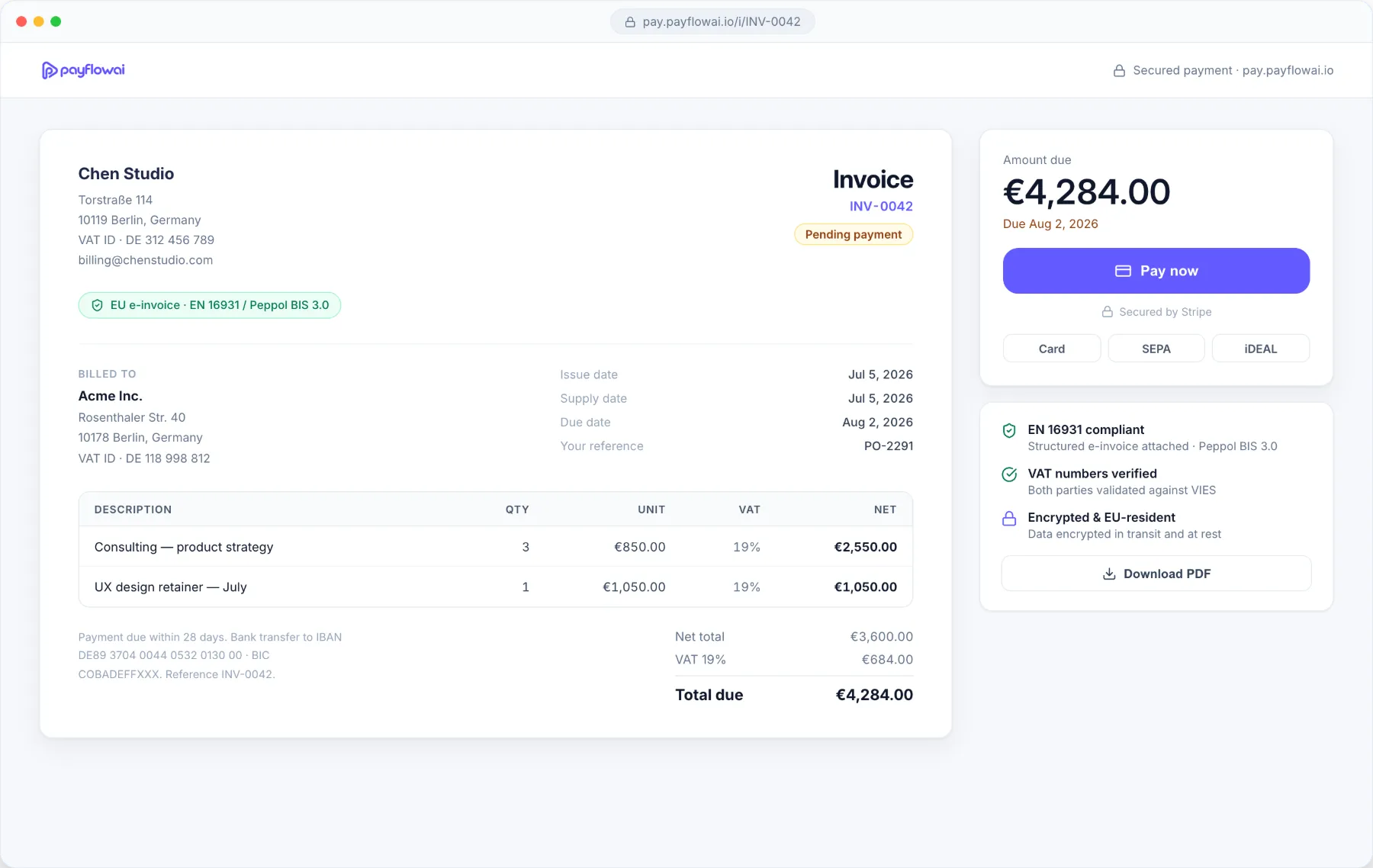
A PDF is a picture of an invoice, made for a person to read. An e-invoice is the same information as labelled data that software can read on its own, the seller's VAT ID, the net amount, the tax, the due date. The new rules require the second kind, which is why simply emailing a PDF will not be enough.
The timeline
When does it become mandatory?
There is no single EU switch-on date. Each country sets its own timeline, leading up to EU-wide rules for cross-border trade in 2030. Today, Germany and Belgium have live B2B mandates.
Germany
2025 – 2028
Every business has had to be able to receive e-invoices since January 2025. The duty to send them phases in from 2027 to 2028, depending on company size.
Live mandate · receiving in forceBelgium
2026
Structured e-invoicing for domestic B2B transactions became mandatory from January 2026, making Belgium one of the first movers.
Live mandateFrance
2026 – 2027
All businesses must be able to receive e-invoices from September 2026, with sending obligations phasing in for smaller businesses through 2027.
Rolling outPoland
2026
The national KSeF e-invoicing system becomes mandatory for businesses during 2026, phased in by company size.
Rolling outAustria
Today
E-invoicing to the federal government is already required. A broader B2B mandate is expected within the ViDA window, voluntary today, but worth preparing for now.
Voluntary for B2B todayEU-wide · ViDA
2030
Structured e-invoicing and digital reporting become the standard for cross-border B2B trade between EU member states from July 2030.
The horizonAm I affected?
Find yourself below
Short, plain answers for the people who ask us most often.
Freelancer in Austria with German clients
If you invoice German businesses, they may already expect to send and receive e-invoices. You should be able to accept one today, and be ready to issue one as Austria moves.
Kleinunternehmer (VAT-exempt)
Not charging VAT does not exempt you from the format rules. In Germany, even small businesses must be able to receive e-invoices, the exemption is about VAT, not about the file format.
Small GmbH or limited company
Registered companies are first in line for sending obligations. Depending on turnover and country, your duty to issue e-invoices may begin in 2027, plan for it now, not later.
Agency invoicing clients abroad
If you bill clients in other EU countries, the ViDA cross-border rules from 2030 are aimed squarely at you. Each client’s home country may also have its own earlier deadline.
Know someone who hasn't heard about this yet?
How PayFlowAI helps
E-invoicing, built into your workflow
From plain English descriptions to validated e-invoice files, PayFlowAI handles the standard steps, so you don't have to.
Natural Language Invoice Creation
Describe what you want in plain English, ‘invoice Acme for three days of consulting’, and PayFlowAI drafts a complete, structured e-invoice for you to review.
XRechnung and ZUGFeRD, built to EN 16931
Each e-invoice is built to the EN 16931 European standard, as XRechnung (XML) or ZUGFeRD (a hybrid PDF with the data embedded), and validated before you send.
The right format for each client
PayFlowAI suggests the format each client needs: XRechnung with Leitweg-ID routing for German public-sector buyers, ZUGFeRD for EU businesses, a plain PDF for everyone else. Change it per client or per invoice whenever you like.
Download-ready files
Pull the ZUGFeRD PDF or the XRechnung XML straight from any invoice, the moment a buyer, portal, or accountant asks for it.
Corrections done right
Finalised invoices are locked and numbered in a gapless series. Need to fix one? PayFlowAI issues a proper credit note (Stornorechnung), with no editing history and no gaps in the record.
Built in the EU, GDPR-native
Every finalised invoice is archived write-once (PDF + XML, hashed) for your records. Built by an Austrian company, with EU data residency and privacy designed in from the start.
E-invoicing isn't a separate step. It sits in the same workflow that creates your invoices, tracks payments and handles follow-ups. See how it works →
FAQ
The questions everyone asks
Straight answers, no jargon, and where a term is unavoidable, it is explained in the same breath.
Is a PDF invoice sent by email an e-invoice?
No, and this is the misconception the whole transition exists to correct. A PDF is a picture made for a human to read. A true e-invoice is structured data that software reads automatically, in a format like XRechnung or ZUGFeRD. Emailing a PDF will not meet the e-invoicing obligation.
What is the difference between a PDF and an e-invoice?
A PDF is built for the eye: a layout that only makes sense once a person looks at it. An e-invoice is built for software: every value, the seller’s VAT ID, the net amount, the tax rate, the due date, is a labelled field another system can import without anyone retyping it. The law increasingly requires the second kind.
When does the e-invoicing obligation begin?
It depends on your country. Germany has required every business to be able to receive e-invoices since January 2025, with sending obligations phasing in from 2027 to 2028 by size. Belgium’s B2B mandate began in 2026, France and Poland are rolling out in 2026 and beyond, and EU-wide cross-border rules apply from July 2030 under ViDA.
Does the obligation apply to Kleinunternehmer and small businesses?
In most cases yes, at least for receiving. In Germany the duty to receive e-invoices applies to all businesses, including small businesses and Kleinunternehmer under the §19 VAT scheme. Being exempt from charging VAT does not exempt you from the format rules. Sending timelines are more generous for smaller businesses, but you should be able to receive an e-invoice today.
What is ViDA?
ViDA stands for VAT in the Digital Age, a package of EU reforms that modernises how VAT is reported. One of its core pillars makes structured e-invoicing and near-real-time digital reporting the standard for intra-EU B2B trade, with the cross-border rules applying from July 2030. Many member states are already moving ahead with their own national mandates.
What is XRechnung?
XRechnung is the German structured e-invoice format built on the European standard EN 16931. It is pure data (XML) that software reads automatically, and it is the format public-sector buyers require. PayFlowAI generates and validates XRechnung for you.
What is ZUGFeRD (Factur-X)?
ZUGFeRD, known as Factur-X in France, is a hybrid e-invoice: an ordinary PDF a person can read, with the structured EN 16931 data embedded invisibly inside it. Your client sees a familiar invoice while their software still gets machine-readable data. It is PayFlowAI’s default send format for EU business customers.
Which e-invoice format does PayFlowAI use?
PayFlowAI suggests a format based on the client. German public-sector buyers get XRechnung with the required Leitweg-ID routing, EU business customers get ZUGFeRD, and non-EU clients get a plain PDF. You can change the format per client or per invoice at any time.
Does PayFlowAI create e-invoices in the required formats?
Yes. PayFlowAI generates both XRechnung (XML) and ZUGFeRD (a hybrid PDF with embedded data) to the EN 16931 European standard, and validates each file before you send. Which rules apply to you depends on your country, your clients and your business, so check the requirements for your situation.
Get started
Start sending e-invoices today
Describe the invoice in plain English, check the suggested format, and PayFlowAI builds and validates the file for you to send.
Questions about e-invoicing for your business? Talk to our team
