How to get paid faster: 7 tactics that actually work
Late payments are a cash-flow problem, not a personality problem. Here are seven concrete changes freelancers and small teams can make this week to shorten the wait between finishing work and getting paid.
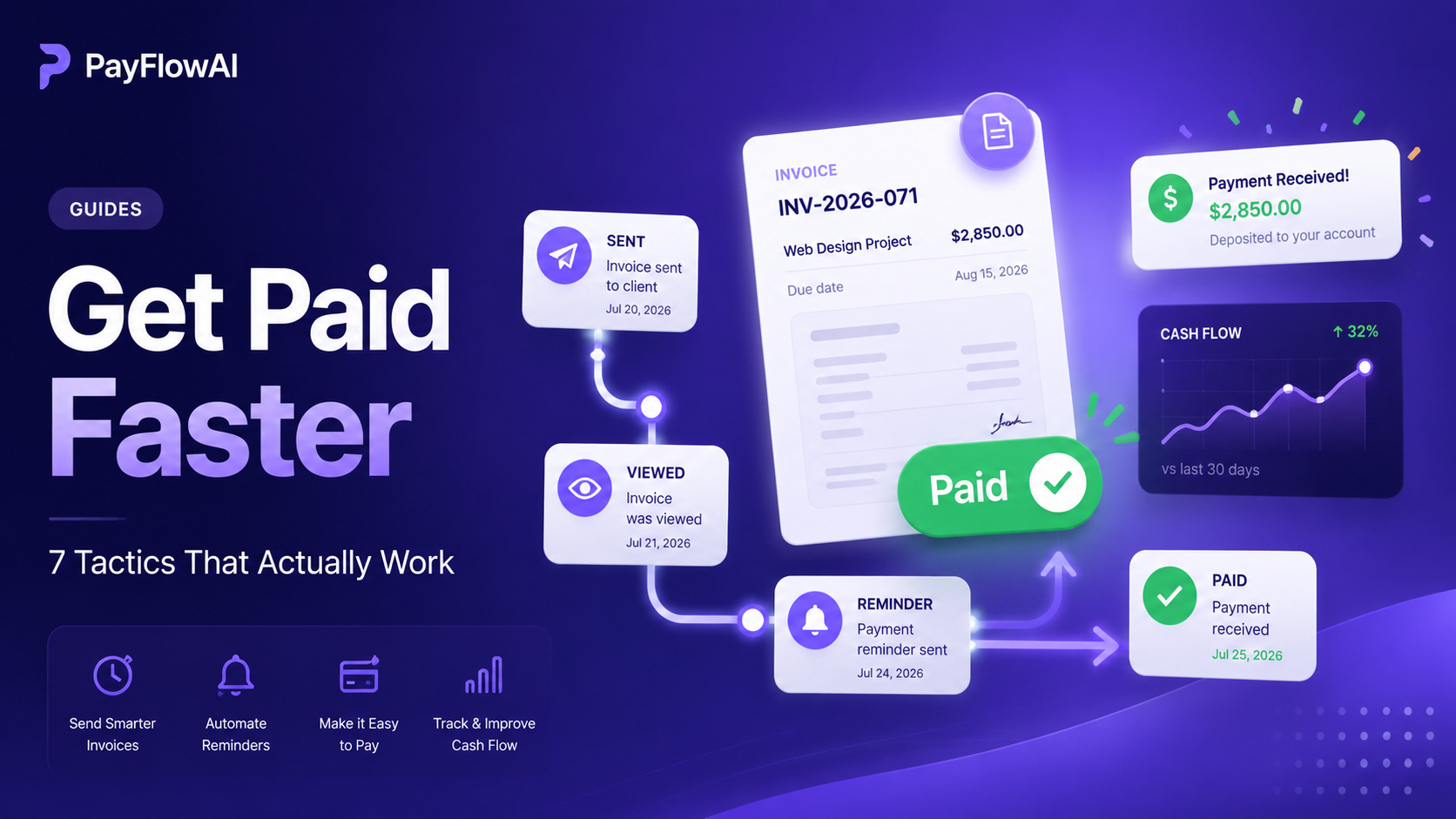
Every unpaid invoice is money you have already earned, sitting in someone else's account. The gap between finishing the work and seeing the payment is rarely about a difficult client. More often it is about small friction points in how you invoice and follow up, and those are fixable.
Here are seven tactics that reliably shorten that gap.
1. Send the invoice the day the work ships
Speed sets the tone. An invoice that arrives the moment a project wraps signals that payment is part of the deliverable, not an afterthought. Every day you wait to send is a day added to the front of the payment clock, and it is the easiest day to remove.
2. Put clear, short payment terms in writing
"Net 30" invites 30 days of waiting, and often more. Shorter, explicit terms move payment forward:
- Net 7 or Net 14 for retainer and repeat clients who already trust you.
- A stated due date, not just "on receipt", so there is no ambiguity.
- Late-payment terms agreed up front, so a reminder later never feels like a surprise.
3. Make paying effortless
Every extra step between "I should pay this" and "done" is a chance for the invoice to slip down the pile. A single click to pay, with the amount and reference pre-filled, removes that friction entirely.
The fastest-paid invoice is the one your client can settle without leaving the email.
4. Follow up on a schedule, not a mood
Most late invoices are not refusals, they are oversights. A predictable follow-up rhythm, a gentle nudge before the due date and firmer reminders after, recovers the majority of them without any awkward phone calls. The key is consistency: the same cadence for every client, every time.
5. Match the tone to the relationship
A first reminder to a long-standing client should read differently from a third notice on a badly overdue balance. Friendly early, professional in the middle, firm when it is genuinely late. Getting the tone right keeps the relationship intact while still moving the money.
6. Track what is actually outstanding
You cannot chase what you cannot see. Knowing, at a glance, which invoices are open, which are overdue, and how much is at stake turns receivables from a source of anxiety into a simple worklist. It also tells you which clients consistently pay late, information worth having before you take on the next big project.
7. Let the routine parts run themselves
Sending, reminding, tracking, and reconciling are all repetitive. That makes them a perfect fit for automation. When the follow-ups send themselves at the right moment and payments reconcile the instant they land, you get the outcome, faster payment, without spending your week on it.
None of these tactics require a hard conversation. They require a system that is fast, clear, and consistent. That is exactly what PayFlowAI is built to do: describe an invoice in plain language, send it in seconds, and let AI-driven reminders and automated payment tracking handle the follow-through, so you get paid faster and get back to the work that pays.