

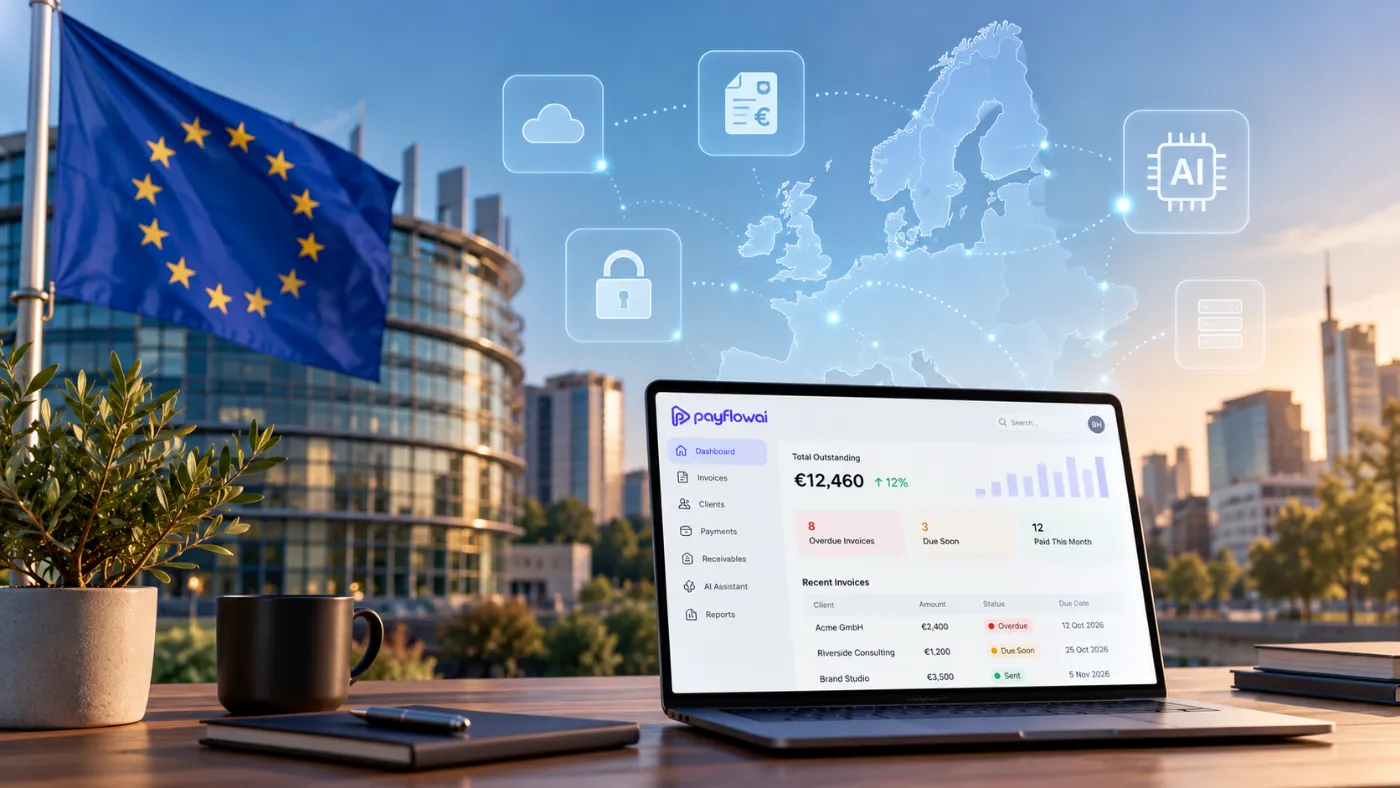
Every time a business sends an invoice, processes a payment, stores a customer record, or uses artificial intelligence to automate a task, it depends on digital infrastructure. Much of that infrastructure is provided by technology companies operating across national borders.
These services create enormous opportunities. They help businesses operate more efficiently, reach new customers, and automate work that once required hours of manual effort. However, they also raise important questions about data ownership, security, privacy, and dependence on individual technology providers.
These questions are central to the concept of digital sovereignty.
The European Union has made digital transformation a strategic priority, seeking to strengthen Europe’s technological capabilities while protecting fundamental rights and supporting a competitive digital economy. In a 2020 briefing, the European Parliamentary Research Service highlighted concerns about Europe’s dependence on foreign technology companies and the need to strengthen control over data, innovation, and digital infrastructure.
Since then, the EU’s digital policy agenda has continued to develop, with greater emphasis on implementing common rules for data, artificial intelligence, cybersecurity, and digital services.
For businesses, the underlying question is straightforward:
How can you benefit from digital technology without losing control over the systems and information your business depends on?
What Is Digital Sovereignty?
Digital sovereignty is the ability of a country, organisation, or individual to maintain meaningful control over its digital technologies, data, and decisions.
At a European level, it means having the capabilities to develop, use, and govern digital technologies in ways that reflect Europe’s economic interests, legal framework, and fundamental values. It does not necessarily mean building every technology within Europe or avoiding international providers. Instead, it means reducing unnecessary dependencies and retaining the ability to make independent decisions.
For an individual business, digital sovereignty is more practical.
It means understanding where your data goes, who can access it, which providers your operations depend on, and what happens if you need to change technology providers. It also means being able to adopt new tools without surrendering unnecessary control over your business information.
Consider a small consultancy that uses online software for invoicing, customer management, accounting, and communication. These tools may be essential to its daily operations, but the business might not know how its information is processed, whether it can easily export its records, or how dependent it has become on a particular provider.
Digital sovereignty encourages businesses to ask these questions before a problem arises.
It is also important to distinguish digital sovereignty from data sovereignty. Data sovereignty focuses more specifically on the control, governance, and legal treatment of data. Digital sovereignty encompasses a wider range of issues, including infrastructure, software, cybersecurity, technological capabilities, and the ability to operate independently.
Both matter in an economy where business operations increasingly depend on connected digital services.
Why Does Digital Sovereignty Matter to European Businesses?
Digital sovereignty is not simply a concern for governments or large technology companies. It has practical implications for organisations of every size.
The European Parliament’s briefing on digital sovereignty identified several challenges facing Europe, including the concentration of technology capabilities outside the EU, dependence on foreign cloud providers, concerns about data protection, and the difficulty European technology businesses face when competing with established global players.
These issues are particularly relevant as businesses adopt more cloud-based services and AI-powered applications.
Protecting business information
Business data can reveal sensitive information about customers, suppliers, commercial relationships, and financial performance. Losing access to that information, exposing it to unauthorised parties, or becoming unable to move it between systems can create significant operational problems.
Digital sovereignty encourages businesses to understand how their data is stored, processed, protected, and shared.
Reducing dependence on individual providers
A business that relies heavily on one software provider may face difficulties if prices increase, services change, integrations disappear, or the provider no longer meets its needs.
Maintaining the ability to export data, connect alternative systems, and move between providers can reduce this dependence.
Complete independence is rarely practical, particularly for small businesses. The objective is to avoid unnecessary lock-in and maintain reasonable alternatives.
Building trust in artificial intelligence
AI can help businesses automate repetitive work, analyse information, and make better-informed decisions. However, these benefits depend on how the technology is implemented.
Businesses need to understand what information AI systems process, how their providers handle that information, and whether important decisions can be reviewed by a person.
Trustworthy AI is therefore not only a regulatory consideration. It is also a commercial requirement for organisations handling sensitive business information.
Strengthening European competitiveness
Digital sovereignty is also connected to Europe’s ability to develop successful technology companies of its own.
The EU’s digital strategy seeks to strengthen European technological capabilities, encourage innovation, improve digital skills, and help businesses adopt new technologies.
For European SMEs, this creates a broader opportunity to benefit from digitalisation while supporting a more competitive European technology ecosystem.
The Key Pillars of Digital Sovereignty
Digital sovereignty is not achieved through a single product, certification, or technology choice. It requires a combination of capabilities and safeguards.
Four pillars are particularly relevant to businesses.
1. Data sovereignty and control
Data is one of the most valuable assets a modern business possesses. Invoices, customer records, transaction histories, and operational information all contribute to how a company functions.
Data sovereignty means maintaining appropriate control over this information, including understanding how it is used and ensuring that the business can access it when needed.
For businesses, this involves choosing providers that explain their data-handling practices, implementing appropriate access controls, and maintaining practical ways to export important records.
European data protection rules, including the General Data Protection Regulation (GDPR), establish important requirements for handling personal data. However, data sovereignty is broader than GDPR compliance alone. It also concerns business continuity, contractual arrangements, technical dependencies, and the ability to change providers.
2. Technological independence
Technological independence does not require a company to build its own software or infrastructure.
Instead, it involves understanding the technologies a business depends on and avoiding unnecessary restrictions that make it difficult to change direction.
Open standards, interoperable systems, documented integrations, and data portability can all help.
For example, a business should consider whether its invoicing software can exchange information with its accounting platform and whether it can retrieve its records in a usable format if it changes providers.
These capabilities become increasingly important as organisations connect more applications and automate more of their operations.
3. Cybersecurity and resilience
Digital sovereignty is difficult to achieve if a business cannot protect its systems or recover from a security incident.
Cybersecurity involves protecting information and digital infrastructure against unauthorised access, disruption, and loss. Resilience goes further by ensuring that the business can continue operating or recover when something goes wrong.
Practical measures include appropriate authentication, access restrictions, secure backups, software updates, incident-response procedures, and careful assessment of technology providers.
The European Parliament has consistently identified cybersecurity as an important part of Europe’s digital transformation. Its digital agenda also reflects the growing importance of common security requirements and cooperation between EU countries.
For businesses, the lesson is simple: security and continuity need to be considered when choosing technology, not added as an afterthought.
4. Trustworthy and responsible AI
As AI becomes part of everyday business software, organisations need to consider how these systems use information and influence decisions.
Trustworthy AI should be implemented with appropriate safeguards, transparency, and human oversight where necessary.
For example, an AI system might help a business identify invoices that require attention or draft a payment reminder. The user should be able to understand the purpose of the recommendation and retain appropriate control over consequential actions.
Businesses should also understand which AI providers receive their data, what contractual protections apply, and whether information is used for model training.
These considerations help organisations adopt AI without overlooking the commercial sensitivity of their information.
What Are the Benefits of Digital Sovereignty?
Digital sovereignty is sometimes discussed in geopolitical terms, but its benefits can be understood through everyday business operations.
- Greater control over business data. Organisations that understand their data flows and maintain access to their records are better positioned to manage information responsibly and respond to changing requirements.
- More flexibility when choosing technology. Interoperable systems and practical export options can make it easier to change providers, introduce new applications, or expand operations.
- Improved risk management. Assessing technology dependencies, security controls, and data-handling practices helps businesses identify potential problems before they disrupt operations.
- Greater confidence in AI. Transparent data practices and appropriate oversight make it easier for employees and customers to understand how AI is being used.
- Stronger long-term resilience. Businesses that plan for provider changes, service interruptions, and evolving requirements are better equipped to adapt.
- Support for a competitive European digital economy. Adopting digital tools and developing European technology capabilities can contribute to a more innovative and competitive business environment.
These benefits are not automatic. A European provider is not necessarily more secure than an international one, and using European infrastructure does not by itself guarantee compliance with applicable laws. What matters is the actual quality of the technology, its governance, and the arrangements surrounding its use.
What Are the Challenges of Digital Sovereignty?
Although digital sovereignty offers important benefits, achieving it involves trade-offs.
Dependence on global technology providers
Many of the cloud platforms, software applications, and AI models used by European businesses are developed or operated by international companies.
Replacing these services is not always practical. Global providers may offer capabilities, reliability, and economies of scale that would be expensive for a smaller organisation to reproduce independently.
The realistic objective is therefore not to eliminate every external dependency. It is to understand those dependencies, assess their risks, and maintain control over important business decisions.
Cost and complexity
Moving between providers, introducing new security controls, or redesigning integrations can require time and money.
For a small business with limited technical resources, these costs must be balanced against the risks being addressed.
A sensible approach is to prioritise the systems that hold the most sensitive information or are most critical to daily operations.
Data portability and interoperability
Businesses often use several applications that do not exchange information seamlessly.
Even when a provider offers an export function, the exported data may not transfer easily into another system. Historical records, attachments, relationships between records, and workflow configurations can all complicate migration.
Interoperability therefore requires more than simply being able to download a file. Businesses should consider whether they can retrieve and reuse their information in a practical way.
Changing regulations and technical requirements
The European digital regulatory landscape continues to evolve.
Businesses may need to consider data protection, cybersecurity, consumer protection, AI-related requirements, and sector-specific obligations, depending on their activities and the services they provide.
Understanding which requirements apply can be difficult, particularly for SMEs without dedicated legal or technical teams.
Digital sovereignty should therefore be approached as an ongoing management responsibility rather than a one-time technology project.
How Can Organisations Achieve Digital Sovereignty?
Businesses do not need to rebuild their technology stack to begin. A few practical steps can help them improve control over their digital operations.
1. Understand where your data goes
Start by identifying the applications that process important business information.
Determine what data each application collects, where it is stored or processed, which third parties may receive it, and who has access.
Pay particular attention to financial information, customer records, employee information, and commercially sensitive documents.
2. Review your technology providers
Evaluate providers based on their security practices, contractual terms, data-handling policies, service reliability, and ability to support your business requirements.
If European data residency is important to your organisation, verify where the relevant data is stored and processed. Also consider the provider’s corporate structure, applicable legal obligations, and use of subprocessors.
Do not assume that a provider’s location alone answers every question about data control.
3. Maintain control over important records
Check whether you can export important business data in usable formats.
Consider what would happen if you had to migrate to another provider. Would you be able to retrieve invoices, customer information, payment records, and historical reports without losing essential information?
For critical systems, document the steps required to recover data or switch providers.
4. Strengthen security and access controls
Use strong authentication, limit access according to people’s responsibilities, and review permissions regularly.
Ensure that appropriate backups and recovery procedures are in place. Understand how providers respond to incidents and what support they offer if a service becomes unavailable.
The level of protection should reflect the sensitivity of the information and the potential impact of disruption.
5. Adopt AI deliberately
Before introducing an AI-powered tool, understand which tasks it performs and what information it needs.
Review the provider’s data-handling arrangements, identify any important limitations, and establish appropriate levels of human oversight.
For financial or customer-facing workflows, consider whether users can review AI-generated recommendations and communications before consequential actions are taken.
6. Avoid unnecessary technology lock-in
Where practical, favour systems that support documented integrations, common data formats, and reliable export capabilities.
Avoid concentrating critical information in a platform without understanding the consequences of leaving it.
You do not need to eliminate every dependency. You need to make deliberate choices about which dependencies are acceptable and how you would respond if they changed.
The Next Frontier: Sovereign AI
Artificial intelligence introduces a new dimension to digital sovereignty.
Traditional software generally processes information according to rules defined by its developers. AI systems can also generate predictions, recommendations, and content based on the information they receive and the models they use.
This creates new questions about data access, transparency, accountability, and control.
The European Parliament’s work on digital transformation highlights the importance of developing AI that is trustworthy and human-centred, while strengthening Europe’s ability to innovate and compete.
The broader idea of sovereign AI builds on this direction. It concerns the ability to develop, operate, or govern AI systems in a way that preserves appropriate control over the technology, its data, and its use.
For some organisations, this may involve using locally operated models or infrastructure. For others, it may mean selecting external AI services with appropriate contractual protections, clear data-handling policies, and controls over how information is processed.
Sovereign AI does not necessarily mean building an AI model from scratch or avoiding every international provider.
For businesses, the practical questions are often more immediate:
- What information does the AI receive?
- Who operates the service?
- Can the organisation control how its data is used?
- Are the system’s outputs reliable enough for the intended task?
- Can a person review important decisions?
These questions are particularly relevant in financial operations.
An AI-powered invoicing platform might draft payment reminders, summarise overdue receivables, or recommend which invoices deserve attention first. Such capabilities can reduce manual work, but they also involve commercially sensitive information and potentially consequential recommendations.
A responsible implementation should make data handling transparent, provide appropriate user controls, and distinguish verified financial facts from AI-generated estimates or suggestions.
For European SMEs, this is where digital sovereignty becomes tangible: not as an abstract debate about who controls the global technology industry, but as a set of decisions about the software they use to run their businesses.
What Does Digital Sovereignty Mean for Invoicing and Accounts Receivable?
Invoicing and accounts receivable are often treated as administrative functions. In practice, they involve some of a company’s most important operational information.
Invoices contain details about customers, products and services, payment terms, and amounts owed. Payment histories reveal commercial relationships, while overdue balances provide insight into a business’s cash flow and financial position.
When these processes are managed across disconnected systems, businesses can struggle to maintain a clear picture of what has been invoiced, what has been paid, and which customers need follow-up.
Automation can help. However, choosing an automated platform also means deciding how sensitive financial information will be handled.
Businesses should look for invoicing and receivables software that makes its data practices understandable, supports access to important records, integrates with relevant systems, and implements appropriate security measures.
When AI is involved, they should also understand which providers process their information and what controls are available over AI-generated actions.
This is particularly important for freelancers, consultants, and small B2B businesses. They need practical tools that reduce administrative work without creating unnecessary complexity or uncertainty about their data.
At PayFlowAI, this is the problem we are working to address.
PayFlowAI is being developed to help freelancers, consultants, and small B2B businesses manage invoicing and accounts receivable more efficiently, from work completed to cash collected.
The broader opportunity is to make the financial workflow simpler and more connected: helping businesses keep track of invoices, understand outstanding receivables, and reduce the manual effort involved in following up on payments.
Digital sovereignty provides a useful lens through which to evaluate these tools. Businesses should not have to choose between operational efficiency and understanding how their financial information is handled.
As AI becomes more integrated into everyday financial workflows, transparency, appropriate data protection, and meaningful user control will become increasingly important considerations.
For PayFlowAI, these are relevant principles to consider as the product develops. They are not a claim that every sovereignty-related requirement is automatically satisfied by using the platform; businesses should always evaluate a software provider’s actual capabilities and data-handling practices.
Frequently Asked Questions About Digital Sovereignty
What is digital sovereignty in simple terms?
Digital sovereignty means having meaningful control over the digital technologies and data you depend on. For a business, it includes understanding where information goes, who can access it, how systems depend on external providers, and whether important data can be retrieved or moved when needed.
What is the difference between digital sovereignty and data sovereignty?
Data sovereignty focuses on the control, governance, and legal treatment of data. Digital sovereignty is broader, covering data as well as software, infrastructure, cybersecurity, technological capabilities, and the ability to make independent digital decisions.
Why is digital sovereignty important for European businesses?
European businesses increasingly depend on cloud platforms, software services, and AI providers. Digital sovereignty encourages them to understand these dependencies, protect sensitive information, maintain flexibility, and make informed decisions about the technology they use.
Does digital sovereignty mean using only European software?
No. Digital sovereignty does not require organisations to use exclusively European technology. International providers can still be appropriate choices. The important considerations include security, data handling, applicable laws, contractual protections, interoperability, and the organisation’s ability to maintain control over its operations.
Is digital sovereignty the same as GDPR compliance?
No. GDPR establishes rules for processing personal data and protecting individuals’ rights. Digital sovereignty covers a wider range of issues, including technological dependencies, infrastructure, data access, operational resilience, and control over digital systems. GDPR compliance can contribute to responsible data governance, but it does not establish digital sovereignty by itself.
What is sovereign AI?
Sovereign AI refers broadly to the ability to develop, operate, or govern AI systems while maintaining appropriate control over their data, infrastructure, and use. Depending on the organisation, this may involve local infrastructure, control over AI models, suitable contractual protections, or transparent arrangements with external providers.
How can small businesses improve digital sovereignty?
Small businesses can start by reviewing where their data is stored and processed, checking provider security and contractual arrangements, maintaining usable exports of important records, strengthening access controls, and understanding how AI tools use their information. These steps can improve control without requiring a complete technology overhaul.
How does digital sovereignty relate to financial software?
Financial software processes information about customers, invoices, payments, and outstanding balances. Businesses should understand how this information is protected, whether it can be exported, which third parties may process it, and how AI features use the data. These considerations are relevant when selecting invoicing, accounting, payment, and accounts receivable platforms.
Conclusion: Digital Sovereignty Starts With Informed Decisions
Digital sovereignty is not about rejecting global technology or attempting to operate without external providers. It is about ensuring that businesses retain meaningful control over the technologies and information on which they depend.
For Europe, this means strengthening technological capabilities, supporting innovation, protecting fundamental rights, and developing a competitive digital economy. For individual organisations, it means understanding data flows, managing technology dependencies, protecting sensitive information, and adopting AI responsibly.
These decisions do not have to begin with a major infrastructure project. They can start with something as simple as reviewing a software provider’s data policies, checking whether important records can be exported, or understanding how an AI tool processes business information.
As digital technology becomes more deeply embedded in everyday operations, these questions will become increasingly important.
For European freelancers, consultants, and SMEs, the objective is straightforward: use technology to operate more efficiently while retaining the control, flexibility, and confidence needed to run a business.
Digital sovereignty is ultimately about making sure that technology serves the business not the other way around.